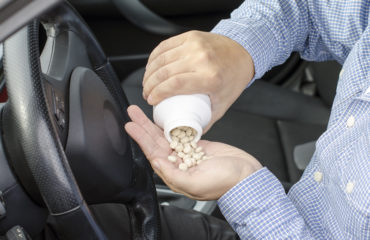


Annually, 1.4 million people are arrested for DWI and 1/3 are repeat offenders.[1] With 500,000 people being rearrested every year, something clearly didn’t work the first time. Impaired driving is a complicated issue, and as with any complicated issue, there must be multiple responses; what stops one person does not necessarily stop someone else. A carpenter does not use just one tool to build a house; the right tool must be used in the right situation. In fighting impaired driving, one useful tool is the 24—7 Sobriety Program.
Impaired Driving and 24-7

Ready for a breath test?
Created in South Dakota in 2005 as a pilot program, 24—7 has grown into a statewide endeavor that is gaining national acceptance. What is 24—7? It is an approach to addressing repeat offenders that requires the impaired driver, either while out on bond or after conviction, to show up at a central location, such as the sheriff’s department, and take a breath test twice a day, every day of the week. The underlying philosophy is if a person is being tested twice a day, morning and evening, it makes it more difficult to drink without getting caught, and if they do, the criminal justice system will know it and respond appropriately. If a breath test is positive, the consequences are “swift and certain.” Typically, the defendants pay a small fee for each test to help fund the program, covering the costs of the officer doing the testing and the use of the equipment.
Does it work? The research indicates, yes, it does. In 2012, the Rand Corporation published a study finding that 24—7 can reduce problem drinking and improve public health outcomes.[2] The study found a 12% reduction in repeat DWI arrests. The program is considered such a success that it has been expanded to other crimes where alcohol is frequently involved, such as domestic violence.[3]
24—7 has also received support from the Federal Government with its inclusion in MAP—21 (Moving Ahead for Progress in the 21st Century), the Federal Highway Transportation Act, with one major distinction: it defines 24—7 solely as a post-conviction program. However, being included in MAP—21 allows a State Highway Safety Office to provide federal funds for a post conviction 24—7 program.
Things to Keep in Mind

There are certain things to consider for 2407
Of course, like any traffic safety program, concerns arise and have to be dealt with. For example, when a defendant learns that he cannot drink because of the frequent testing, he may decide to use a different drug to get high. That problem is easily remedied with random urine screens testing for other drugs. Another issue is requiring a defendant to appear at a central location when she may not have a license to drive, especially if she is a repeat DWI offender or lives in a rural area. Other technologies, such as Transdermal Alcohol Monitoring Devices, which test for alcohol continuously, are used in many of these situations. While it is more expensive, it allows for the person who cannot appear to still be tested. Ignition interlock devices (IID) are also being used as a testing tool. While not designed for that purpose, requiring the defendant to start the car twice a day by breathing into an interlock[4] can give similar test results.[5]
Additionally, what about those individuals who are addicted to alcohol – how does this change their behavior? It doesn’t—long-term treatment is needed. But 24—7 can still be an important part of the process. It is just as critical, if not more, to know when an addicted person uses alcohol in violation of a court’s order.
Creating a 24-7 Program
Setting up a 24—7 program can be fairly straightforward. Some of the steps are:

Any new idea takes work to create
- Obtain an order from the court, either through bond conditions or a probation order
- Find an agency that will perform the tests
- Establish a central location for testing
- Determine the court’s response for the first positive test, and the second one, etc.
- Decide how much the defendant will pay, or if it will it be funded through a grant or other funding source
- Obtain other alternative testing procedures if the defendant is not able to get to the location
- Resolve how often urine or other testing is going to be done to determine other drug usage
No tool is for every use, all of the time. It is the combination of supervision, accountability, long-term treatment when appropriate, and frequent alcohol and drug testing that can show the way and make a difference. But there is no question that 24—7 is one more tool that should be in the court’s toolbox in the comprehensive fight to end impaired driving.
[1] Traffic Safety Facts: Repeat Intoxicated Driver Laws, National Highway Traffic Safety Administration, January 2008, DOT HS 810 879
[2] Beau Kilmer, Nancy Nicosia, Paul Heaton, and Greg Midgette. Efficacy of Frequent Monitoring With Swift, Certain, and Modest Sanctions for Violations: Insights From South Dakota’s 24/7 Sobriety Project. American Journal of Public Health: January 2013, Vol. 103, No. 1, pp. e37-e43
[3] The Rand Study also looked at the impact of 24—7 with domestic violence cases and found a 9% reduction in domestic violence arrests.
[4] This type of test does not require the defendant to drive anywhere, just go out to the car and start it.
[5] These other technologies will be discussed in more detail in later blogs.
Related articles
- Combating DWI – Have We Done Enough? (trafficsafetyguy.com)
- AG releases results of sobriety program (siouxcityjournal.com)
- Wyoming lawmakers take serious look at South Dakota’s 24/7 Sobriety Program (trib.com)