


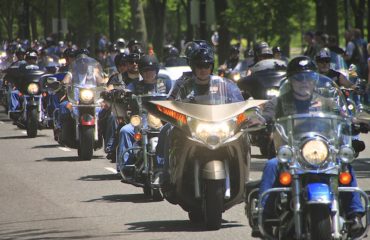
Summertime means heading to the beach; it means cookouts with family and friends; it means fresh food from the garden; it means hitting the road to see the sights. Summertime also means motorcyclists will be out enjoying the warmer weather. How many motorcyclists, you ask? More than ever before. In 2011, there were almost 8½ million registered motorcycles, up from 5 million in 2002.[1] And, while motorcycles account for only 3% of all registered vehicles and a mere 0.6% of all vehicle miles traveled, the 4,612 motorcyclists killed in 2011 accounted for 14% of all traffic fatalities. These numbers translate to a disturbing statistic: motorcyclists are 30 times more likely to be killed in a traffic crash than someone in a passenger car.[2]
Motorcycles and Road Safety

Thousands of Motorcycles Riding in Washington DC
There are a number of factors causing these alarming statistics. They include:
- Motorcyclists not wearing a DOT-compliant helmet
- Speeding by the motorcyclist
- Operating while impaired by alcohol or drugs, and
- Drivers of other vehicles not seeing the motorcycle
Forty percent of motorcyclists killed in 2011 were not wearing helmets; 35% were speeding; 30% were impaired with a BAC of .08 or higher; and, almost 20% of the fatal crashes involved a car turning left in front of a motorcycle.[3] Of course, there can be overlap between these factors. For example, many of the impaired motorcyclists killed were not wearing a helmet. It also is noteworthy that 22% of the motorcyclists were operating their motorcycles without a valid endorsement or motorcycle license.[4] While this is not a direct cause of the fatalities, it is an indication that the motorcyclists were not properly instructed or trained on motorcycle operation.
We Need a Comprehensive Approach

Stop Impaired Riding message
What is clear from all of the numbers is that motorcycle fatalities are a significant concern and, like so many traffic safety issues, it will take a comprehensive approach to make a difference. It will take all motorcyclists wearing appropriate safety gear, including a DOT-compliant helmet and high visibility gear. It will take motorcyclists not drinking and driving, just like every other driver on the road. It will take novice and experienced riders to reacquaint themselves with their bike, and consider taking training courses on operating a motorcycle. A significant percentage of new motorcycle registrations were bought by baby boomers with extra cash getting their dream motorcycle. Many have not ridden in years, if at all. But today’s motorcycles are larger and more powerful than 20 and 30 years ago, and there are more motor vehicles on the road. With appropriate training, motorcyclists can learn to ride more safely; they can learn defensive riding techniques; and, if they are older, accept that their riding skills may have diminished because of age.
Motorcyclists are not the only ones that have to change their behavior. Other drivers must take the time and make the effort to actually be aware of their surroundings, including motorcycles. Motorcycles are smaller, thus harder to see or to judge their speed. We all must drive aware and alert. We all must take that extra moment to look for motorcyclists. Motorcycle safety requires all of us to allow more distance when following a motorcycle, and for all of us to always signal before changing lanes or merging with traffic. Minor road conditions for a car, such as a pothole or pavement seams, can be a major hazard for a motorcycle, where the operator may have to react quickly to avoid the risk.

Share the Road Poster
Remember – Share the Road!
“Share the Road”[5] is a clear message that motorcyclists have the same rights and privileges as any other motor vehicle on the road. It is time that all of us recognize the significant role we play in motorcycle safety and saving lives. May was Motorcycle Safety Month, the month where there is typically an initial surge in ridership across the country. But it is not just May when motorcycle safety is critical; every day, of every month, of every year is a critical time for motorcycle safety.
[1] Traffic Safety Facts, Motorcycles, 2011 Data, National Highway Traffic Safety Administration, DOT HS 811 765 (May 2013).
[2] Traffic Safety Facts, Motorcycles, 2011 Data, National Highway Traffic Safety Administration, DOT HS 811 765 (May 2013).
[3] Traffic Safety Facts, Motorcycles, 2011 Data, National Highway Traffic Safety Administration, DOT HS 811 765 (May 2013).
[4] Traffic Safety Facts, Motorcycles, 2011 Data, National Highway Traffic Safety Administration, DOT HS 811 765 (May 2013).
[5] NHTSA developed model “Share the Road” language by reviewing material used by motorcycle safety agencies and national organizations that have a vested interest in increasing motorcycle safety.

[…] Motorcycle Safety: It’s For Everyone (trafficsafetyguy.com) […]